

Tick bite ER visits spike in Northeast: How to prevent or remove ticks

NYC sees tick population surge in 2025
The tick population is booming this summer, not only in the suburbs but also across the five boroughs. FOX 5 NY's Kendall Green breaks down why the tiny but dangerous bugs are posing a significant risk to New York City residents engaging in outdoor activities.
NEW YORK CITY - Emergency room visits from tick bites have spiked this summer, especially in the Northeast, compared to past years.
What we know:
Data from the Center for Disease Control and Prevention (CDC) shows that ER visits regarding tick bites in the Northeast for June reached the highest numbers since 2019.
For July, ER visits for tick bites per 100,000 visits in the Northeast increased to 147 this year, compared to 92 in 2024.
Big picture view:
From a countrywide perspective, ER visits from tick bites for July of this year have been the highest since 2017.
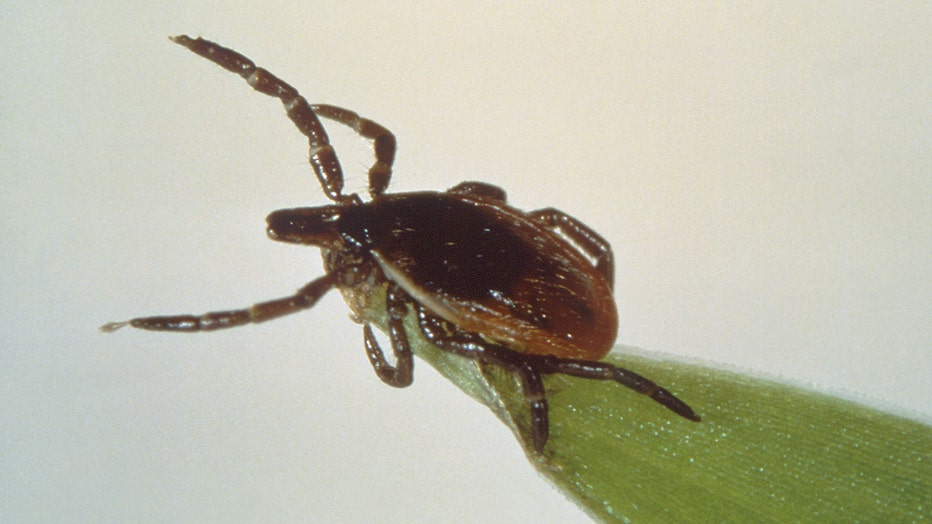
A deer tick; also called a blacklegged tick; Ixodes scapularis. (CDC Photo)
Local perspective:
The tick population has been high in New York City this summer, due to an abundance of acorn-eating animal populations, reported FOX 5 NY's Kendall Green.
According to the Fordham Tri-State Tick Risk Index, the risk of being bitten remains at high risk for the week of July 25, with a seven on a 10-point scale.
Various types of tick populations have been found across the city, including deer ticks, lone star ticks, Asian longhorned ticks and the American dog tick.
Featured
NYC sees tick population surge in 2025
The Fordham Tick Index indicates a high risk of ticks in New York City due to increased acorn-eating animal populations.
Lyme disease
Bacteria transmitted by infected deer tick causes Lyme disease, according to the New York State Department of Health.
Lyme disease can be transmitted when an infected tick bites a person and stays attached for a period of time.
Symptoms of Lyme disease
According to NYS Department of Health, in most cases, a rash or multiple rashes resembling a bull's eye or solid patch, about two inches in diameter, appears and expands around or near the site of the bite.
Symptoms appear within three to 30 days of the bite, and usually start off with chills and a fever that are accompanied by a headache, fatigue, stiff neck, muscle and/or joint pain and swollen glands.
Tick bite prevention
What you can do:
The CDC advises that reducing exposure to ticks is the best defense against tick bites.
Some steps for prevention are using Environmental Protection Agency (EPA)-registered insect repellents, products containing 0.5% permethrin on clothing and gear, checking clothing, body, gear and pets after coming indoors and showering soon after being outside, the CDC website says.
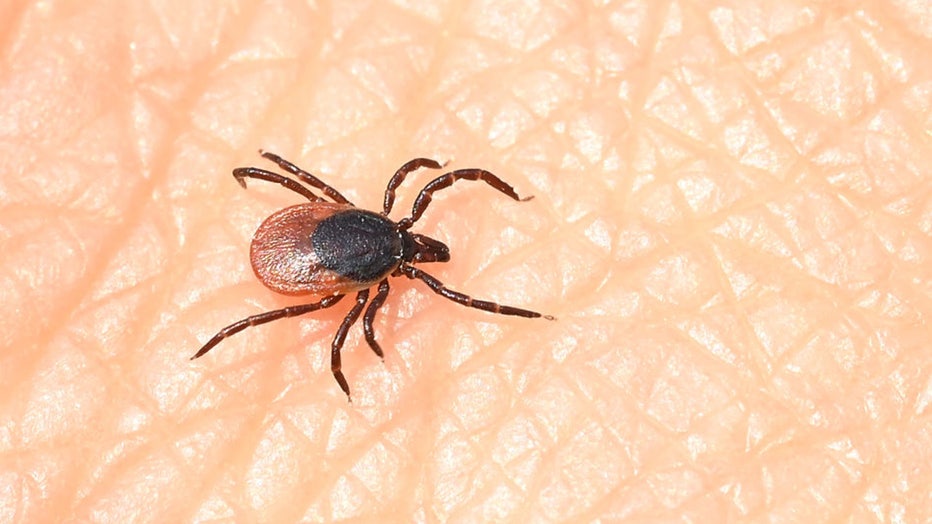
FILE - A tick runs over a hand. (Bernd Weissbrod/picture alliance via Getty Images)
What to do after a tick bite
The CDC shared on their website that ticks should be removed from the body as soon as possible, without waiting to go to a healthcare provider for removal, to decrease chances of tickborne diseases.
Steps on removing ticks with tweezers:
The CDC has posted a five-step routine to remove ticks that have attached to the skin.
- Grasp the tick as close to the skin's surface as possible using clean fine-tipped tweezers. If fine-tipped tweezers are not available, use regular tweezers or your fingers to grasp the tick. Grasp the tick close to the skin's surface to avoid squeezing the tick's body.
- Pull tick away from the skin with steady, even pressure. Don't twist or jerk the tick. This can cause the tick mouthparts to break off and remain in the skin. If this happens, your body will naturally push the mouthparts out over time as your skin heals. You can also remove the mouthparts with tweezers. If you cannot remove the mouthparts easily with tweezers, leave them alone.
- Dispose of the live tick by taking one of these steps: place it in a sealed container; wrap it tightly in tape; flush it down the toilet; or put it in alcohol. Do not crush the tick with your fingers.
- After removing the tick, thoroughly clean the bite area and your hands with soap and water, rubbing alcohol, or hand sanitizer.
- If you find a tick attached to you, there may be other ticks on your body. Do a careful tick check to look for other ticks and promptly remove them.