

Here's where NYC's mayoral candidates stand on 4 of the biggest issues

2025 NYC mayoral race debates
From scavenger hunts and potato chip gags to failed weightlifting attempts, candidates spent the weekend drawing attention on the trail while sharpening their attacks.
NEW YORK - The 2025 election for New York City's next mayor is quickly approaching.
Now that current Mayor Eric Adams has dropped out of the race after months of speculation, the election is really down to three major candidates: Democratic nominee Zohran Mamdani, former Gov. Andrew Cuomo and conservative activist and talk show host Curtis Sliwa.
JUMP TO:
While there are a number of issues plaguing voters across the city, polls have indicated that New Yorkers of all stripes are concerned about the price of housing and the state of crime and public safety within the city.
In recent years, enrollment in the city's public schools has plunged as well, indicating a dissatisfaction with the system as a whole. Health care access and affordability were two of the largest policy concerns of voters nationally during the 2024 presidential election, and voters across New York City have continued to worry heading into November's election, as well.
Here's an overview of where Mamdani, Cuomo and Sliwa stand on these four major issues.
Zohran Mamdani
Housing access and affordability
Mamdani's housing plan has four pillars, according to his campaign website.
He plans to freeze rent for all stabilized tenants as mayor, and "use every available resource" to build additional housing throughout the city.
"The number one reason working families are leaving our city is the housing crisis," his platform states. "The Mayor has the power to change that." According to the New York City Charter Revision Commission, NYC faces "what is likely the worst housing affordability crisis in its history."

Mamdani reacts to Adams’ 'insidious forces' claim, warning
Democratic nominee for New York City mayor, Zohran Mamdani, joined Good Day New York.
As mayor, Mamdani plans to triple New York's production of "permanently affordable, union-built, rent-stabilized homes" in order to construct 200,000 units over the next decade. He also plans to "overhaul" the Mayor’s Office to Protect Tenants and "coordinate code enforcement under one roof" in order to ensure agencies work together to hold landlords accountable for the conditions of the buildings they own.
Mamdani also plans to create a new Office of Deed Theft Prevention to protect homeowners from a "system that favors wealthier homeowners in gentrifying neighborhoods."
"Home ownership is out of reach for too many," Mamdani wrote on X in May. "And those who do own face rising costs and predatory scams. I saw these challenges up close as a foreclosure prevention counselor. As Mayor, I'll make city government work for you."
Crime and public safety
As mayor, Mamdani plans to create the Department of Community Safety to "prevent violence before it happens by prioritizing solutions which have consistently shown to improve safety," per his campaign website.
The department would be tasked with responding to mental health crises and combating homelessness.
Mamdani acknowledges that the police have a "critical role to play" in managing public safety, but that "right now, we’re relying on them to deal with the failures of our social safety net—which prevents them from doing their actual jobs."
He plans to keep the NYPD officer headcount the same, but cut the department's overtime spending.
During a press conference with Sen. Elizabeth Warren earlier this year, Mamdani reiterated his stance, saying that "forced overtime" is a main contributor to officers leaving the department, and that he wants "to empower police officers to respond to serious crime and hire mental health professionals to respond to mental health calls."
Mamdani has also pledged to disband the NYPD's Strategic Response Group (SRG), one of the force's special operations units. He claims the unit "has cost taxpayers millions in lawsuit settlements + brutalized countless New Yorkers exercising their first amendment rights."
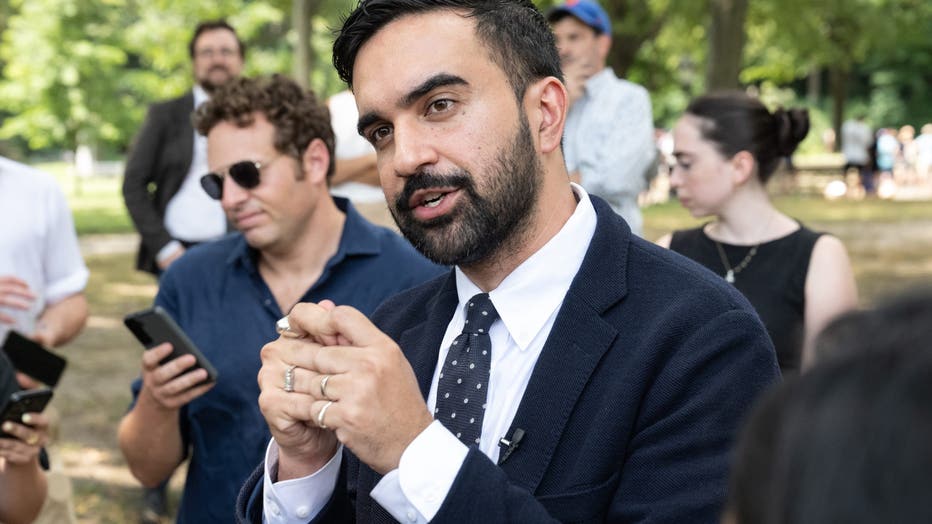
NEW YORK, NEW YORK - AUGUST 17: New York mayoral candidate Zohran Mamdani attends a campaign event on August 17, 2025 in Prospect Park in New York City. The Siena College poll released last Tuesday shows Mamdani leading by 19 points over his next-clo
Education
As mayor, Mamdani has vowed to "ensure our public schools are fully funded with equally distributed resources, strong after-school programs, mental health counselors and nurses, compliant and effective class sizes and integrated student bodies."
Mamdani is a proponent of the Open Streets for Schools program, which allows any New York City school to limit vehicle traffic on the street near or in front of the school building. Some schools just open the street during arrival and dismissal times, but others use the space to host recess or outdoor learning programs, according to OpenPlans.
Mamdani also plans to address student homelessness by "expanding the successful Bronx pilot Every Child and Family Is Known," which aims to improve the well-being of NYC public school students living in shelters by establishing mentor relationships and inter-agency collaborations with city agencies for support.
A Mamdani administration would also provide new parents and guardians with a collection of essential resources free of charge. These include diapers, nursing pads, baby wipes and more, his platform states. Each NYC Baby Basket will also include a resource guide on the city’s newborn home-visiting program, post-partum depression, breastfeeding and more.
Mamdani also plans to "implement free child care for every New Yorker aged 6 weeks to 5 years" and bump up the pay for child care workers to that of the city's public school teachers. He also plans to work with the city and state to "massively" invest in CUNY, the public university system in New York City.
Health care
In order to expand access to health care for New York City residents, Mamdani's platform states that as mayor, he'll create a "new corps of outreach workers" within the sector.
These workers, Mamdani states, will support patients by informing them of the resources available. They'll learn about how to find insurance, get financial assistance and claim health benefits.
Mamdani also wants to increase funding for hospitals in the city, protect the city from future health emergencies similar to COVID-19 and work to end hospital closures.
If elected, Mamdani claims he'll reject Medicare Advantage plans as well, which can lead to higher out-of-pocket costs for specific services.
Andrew Cuomo
Housing and affordability
Former Gov. Andrew Cuomo, who is now running as an independent after losing the Democratic primary to Mamdani, states in his platform that New York City faces a crisis of affordability and a crisis of housing.
"Our city has always been expensive, but today it is rapidly becoming unaffordable for millions of hard-working New Yorkers at all income levels," Cuomo states on his campaign website. "The existing supply of housing is increasingly unaffordable, and its quality is deteriorating."
This is why building "more housing across all income levels" is essential, Cuomo says. As mayor, Cuomo states that he'll additionally increase enforcement of rent-stabilization to address housing affordability.
Cuomo also wants to provide "targeted tax relief to lower-income and middle-class voters, including homeowners," as well as "leverage public land" for affordable and mixed-income housing development.
Crime and public safety
Increasing the size of the New York Police Department (NYPD) to the size of its force 25 years ago is essential to ensuring New Yorkers and visitors feel safe, Cuomo's platform states—he plans to add 5,000 new police officers to the NYPD if elected.
In order to "increase officer retention" and "boost morale" within the department, active and recently retired officers will also be offered bonuses. Officers will also redirect their focus to recidivists, who Cuomo claims are responsible for a "disproportionate share of crime." He's correct, according to the Journal of Criminal Justice.
Cuomo's platform also states the former governor's intention to "increase the permanent presence and deployment of NYPD and Metropolitan Transit Authority (MTA) officers" in subway stations across the city. He says his administration would work with District Attorneys to better address crime on subways, such as vandalism and drug use.
The NYPD would also focus more on retail theft under a Cuomo administration.
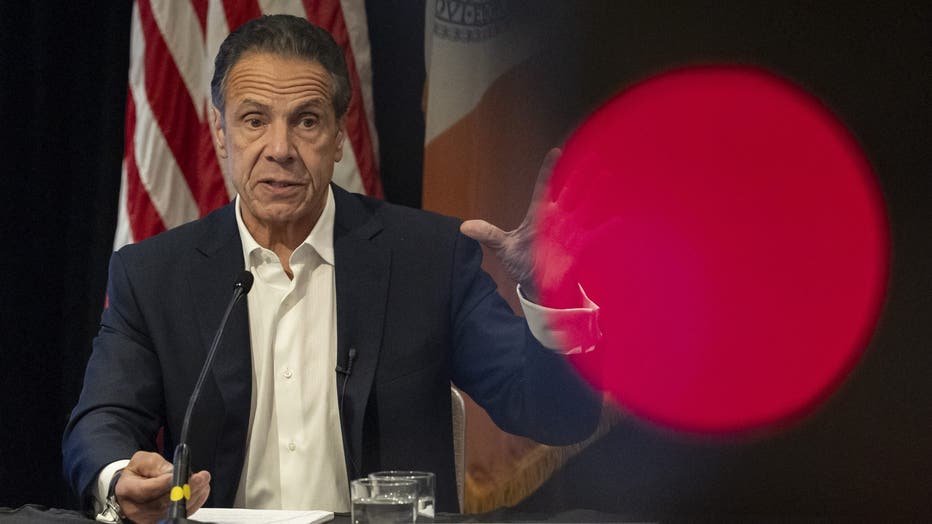
New York City mayoral candidate Andrew Cuomo speaks during a press conference Thursday, Aug. 7, 2025, in New York. (AP Photo/Yuki Iwamura)
Education
According to Cuomo's platform, the Mayor of New York City "has no higher calling than ensuring that the more than 900,000 students enrolled in the New York City public school system receive a high-quality education."
The best way to go about ensuring this, Cuomo states, is by reducing class size, expanding after-school programs, addressing chronic absenteeism among students and emphasizing career and technical education.
Cuomo also believes that retaining teachers is essential to children having a consistent education. Like many districts across the United States, New York City lost a number of teachers post-pandemic. In order to help teachers stay within the profession, the city needs to address working conditions in the city's schools and improve safety and mentoring, Cuomo's platform states.
Cuomo also wants to "increase the number of School-Based Health Centers" in the city, which provide services such as preventive care to NYC students through the 12th grade.

NYC Mayoral Race Heats Up in Final Days | Battleground NYC full episode #46: Oct 1, 2025
As we enter the October home stretch to Election Day, the race for NYC Mayor is heating up. Host S.E. Cupp is joined by Kavain Shroff, an attorney and Democratic commentator, to break down the news and offer analysis on the race.
Health care
Cuomo's health and wellness plan aims to "improve the health of all New Yorkers," according to his platform.
In order to ensure that residents have access to primary care and specialty care when needed, a Cuomo administration would partner with "federally-qualified community health centers" as well as physician associations in order to provide community-based care.
Building on that idea, Cuomo's platform also states an intention to bring health care services to additional schools and public housing complexes in the city.
More broadly, Cuomo's team plans to focus on "core public health functions," such as pandemic preparedness and childhood vaccinations. A Cuomo administration also plans to "reduce health disparities" in maternal health and chronic diseases like diabetes by formulating concrete plans on how to address them.
Curtis Sliwa

Sliwa calls Adams a ‘crook’ after dropping out of mayor’s race
Republican nominee for New York City mayor, Curtis Sliwa, joined Good Day New York.
Housing and affordability
While Sliwa agrees that building more affordable housing is important, he claims on his campaign website that "this approach alone will not address the affordability crisis" plaguing NYC.
Sliwa has a seven-point plan that he claims will make housing more affordable for working people. Some of his proposals include "restoring" the city's vacant rent-controlled apartments, "expanding" housing for seniors, "converting commercial spaces into housing" and "restoring" local zoning control.
"Rather than handing control to corporate developers, I will ensure that zoning decisions prioritize affordability and community stability," his platform states.
Crime and public safety
Like Cuomo, Sliwa wants to hire several thousand additional NYPD officers to "restore law and order across NYC."
He additionally wants to do a better job "recruiting, retaining and promoting" existing police officers, as well as uplifting the "rank and file NYPD."
Sliwa wants to reinstate the Homeless Outreach Unit, as well, which he says will "help distinguish between those in need of services and those who pose a danger."
His platform also states his intention to reform internal oversight standards, address retail theft, crack down on illegal street racing, educate New Yorkers on crime prevention, support community safety partners and more.
His 15-point plan can be read here.
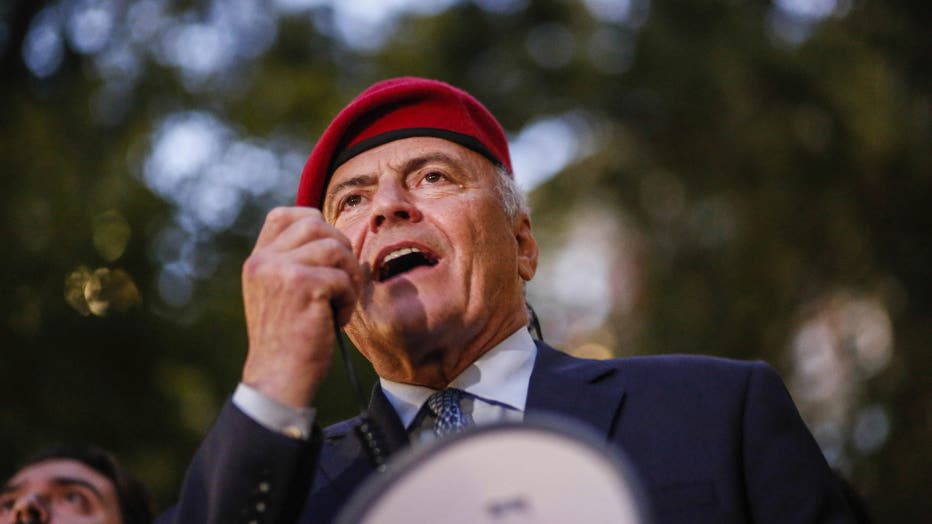
New York City Republican mayoral candidate Curtis Sliwa speaks during a New York Young Republicans Club vigil for Turning Point USA CEO and co-founder Charlie Kirk at Madison Square Park on Friday, Sept. 12, 2025, in New York. (AP Photo/Kena Betancur
Education
Sliwa's campaign website states that New York City's public schools are "failing too many kids."
"Despite a record-breaking $40 billion budget and spending over $32,000 per student, classrooms are underfunded, teachers are paying for supplies out of pocket and student achievement is stagnant," his platform reads.
Sliwa is in favor of "overhauling" how NYC's public school system works by coming up with an entirely new model with "clear goals and measurable outcomes."
He wants to ensure safety in school by "restoring" school safety agents under the NYPD. He also believes that education should stay "focused on proven methods" such as phonics-based reading comprehension and structured math instruction.
Like Adams, Sliwa also wants to grow gifted and talented programs across all five boroughs and increase vocational education. He plans to address truancy through counseling and mentorship, as well.
His 10-point plan can be read here.
Health care
During the Medicare Advantage debacle between Mayor Adams and advocates, Sliwa spoke out, vowing to "leave retiree health care as permanently traditional Medicare."
He called switching the Medicare Advantage Plans "ill-advised."
"On Day One, I will order my Corporation Counsel to withdraw all appeals and allow our retirees to finally retire in peace. That’s my pledge," he said on X.
Several of his proposals would contribute to overall public health as well, as much of his platform has to do with cleaning up NYC's public spaces and streets. He wants to increase street cleaning and trash collection across the whole city, increase funding for extermination and pest control and enforce sanitation rules for restaurants, landlords and more.
The Source: Information above was sourced primarily from the candidates' platforms, which are publicly available, as well as previous FOX 5 NY reporting. Social media, the JAMA Network, Chalkbeat New York, the Journal of Criminal Justice, PBS, the National Council on Aging, the NYC Children's Cabinet, OpenPlans, Fox News, the NYC Charter Revision Commission, the Brookings Institution and Public Health Solutions were also used for sourcing.