

Blood Moon March 2026: Total lunar eclipse times and viewing guide

NEW YORK - A total lunar eclipse, commonly known as a Blood Moon, will be visible in the early morning hours of March 3, 2026, and skywatchers on the East Coast are encouraged to look west before sunrise as the Moon sets during the event.
How does a lunar eclipse work?
NASA explains that a lunar eclipse happens when Earth passes directly between the Sun and the Moon, casting a giant shadow on the lunar surface. When the Moon enters Earth’s umbra — the darkest part of the shadow — the full Moon can take on a reddish-orange hue because sunlight filtering through Earth’s atmosphere bends and scatters, letting red wavelengths reach the lunar surface.
This red coloration is why eclipses like this are often called Blood Moons.
How can I observe the eclipse?
According to NASA, you don’t need any special equipment to watch a lunar eclipse — it’s safe with the naked eye — though binoculars or a small telescope will enhance the experience.
For the East Coast, a clear view of the western horizon before and around sunrise on March 3 will give viewers the best chance to see totality as the Moon sets.
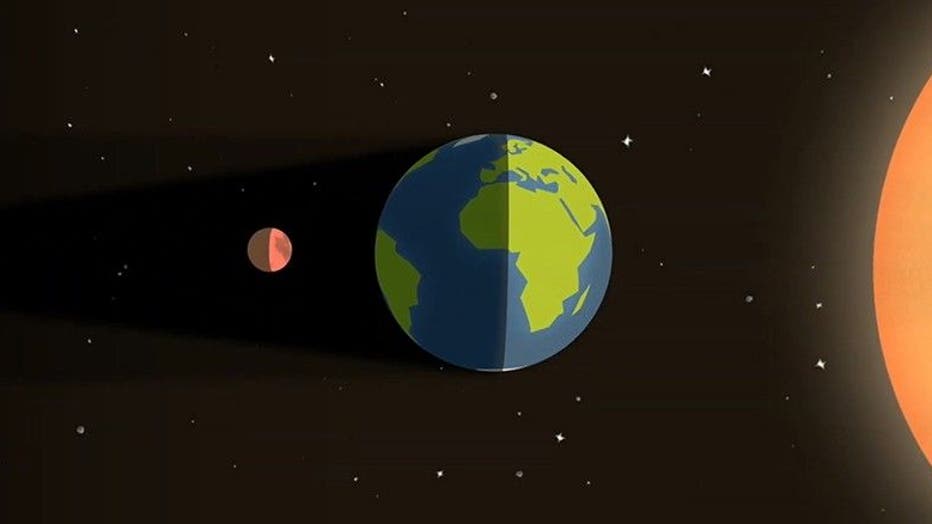
Alignment of the Moon, Earth, and Sun during a lunar eclipse (not to scale). NASA's Scientific Visualization Studio
What time is the lunar eclipse?
NASA’s timeline for the event gives a clear picture of the stages of the eclipse:
- Penumbral eclipse begins: 3:44 a.m. EST — Moon enters Earth’s penumbral shadow and begins to dim.
- Partial eclipse begins: 4:50 a.m. EST — Earth’s umbra starts to cover the Moon.
- Totality begins: 6:04 a.m. EST — Moon fully in Earth’s umbra, taking on a reddish hue.
- Totality ends: 7:03 a.m. EST — Red coloration fades.
- Eclipse ends: about 9:23 a.m. EST — Moon exits the penumbra.
Because the Moon will be setting in the west during totality for Eastern U.S. observers, much of the best viewing will be shortly before and during the early stages of the eclipse.
Why is it called a "Blood Moon"?
As NASA’s Q&A explains, the reddish appearance happens because light from all of Earth’s sunrises and sunsets is refracted around the planet and onto the Moon’s surface — essentially painting it with red and orange hues during totality.
Why this eclipse matters
This total lunar eclipse will be the only total lunar eclipse of 2026 visible from North America, and it’s the last until late 2028, making it a rare chance for skywatchers in the region.
The Source: This article was written using information from NASA, Space.com and Starlust guides on the March 2026 total lunar eclipse.