

What Trump's $12 billion farmer bailout package could mean for grocery prices

FULL: Trump holds roundtable, announces $12 billion farmer aid package
President Donald Trump held a roundtable at the White House on Monday regarding farm aid.
WASHINGTON - President Donald Trump announced a $12 billion farm aid package intended to help farmers whose businesses have been hit hard by rising costs during a White House roundtable on Monday.
As noted by the AP, and more specifically, the funds are intended to help farmers who have "suffered from trade wars with other nations, inflation and other market disruptions."
Trump made the announcement alongside Agriculture Secretary Brooke Rollins, Treasury Secretary Scott Bessent and Director of the National Economic Council Kevin Hassett.
The majority of the money – $11 billion – has been set aside to issue one-time payments for farmers of row crops such as rice, soybeans, wheat and corn, according to a White House official who spoke with POLITICO ahead of Monday's announcement. Most of these funds will come from the Agriculture Department’s Farmer Bridge Assistance program, according to the U.S. Department of Agriculture.
The remaining funds will be reserved for fruit and vegetable farmers, as well as growers of other "specialty crops" such as tree nuts and dried fruits.
Rollins said that farmers will start receiving their chunk of the funds by Feb. 28, and that applications for the money will open in the coming weeks.
"The plan we are announcing today ensures American farmers can continue to plan for the next crop year," Rollins said in a statement. "It is imperative we do what it takes to help our farmers, because if we cannot feed ourselves, we will no longer have a country."
The backstory:
This announcement comes after "months of promises" from Trump and other administration officials to "provide relief for farmers reeling from the president’s trade wars and rising production costs," according to POLITICO.
Although farmers have historically backed the president, Trump's combative approach to trade policy has come under fire in recent months due to the effect it's had on the agriculture sector and consumers.
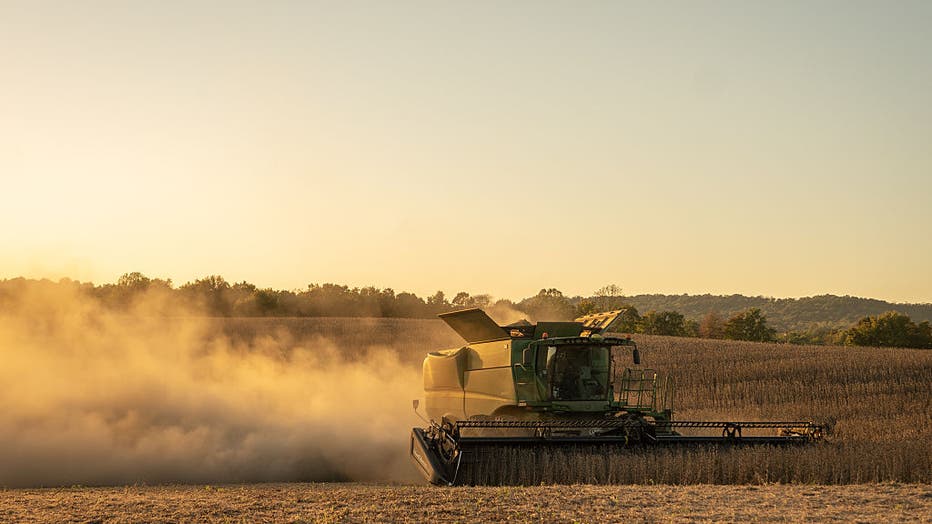
MARION, KENTUCKY - OCTOBER 14: A combine harvests soybeans on October 14, 2025 in Marion, Kentucky. U.S. soybean farmers are being negatively impacted by the Trump administration's ongoing tariff dispute with China. (Photo by Jan Sonnenmair/Getty Ima
According to the Tax Foundation, a nonpartisan tax policy nonprofit, Trump's tariffs have so far "raised retail prices on average by about 4.9 percentage points," based on the latest data through early October.
Last month, the president rolled back tariffs on over 200 food products such as beef, bananas and coffee in the face of growing criticism from consumers.
Will farm aid affect your grocery bill?
What's next:
The farm aid bailout package will have limited immediate impact on grocery prices, as an economic policy change such as the one announced Monday will take time to reach grocery shelves. This is called response lag, or impact lag, which is "the delay between policy implementation and its impact on the economy," according to Investopedia.
Basically, the funds will be used to help U.S. farmers pay off their debts and plan financially for next year's planting, which will in turn ensure that they can keep producing food, and therefore stabilize the U.S. food supply.
Food shortages fundamentally drive prices up for consumers – it's basic supply and demand. When there's less food to go around, the price of what's available in turn goes up. With this bailout package, the Trump administration is aiming to prevent those shortages.
All in all, the citizen-level effect of the package will take time to be felt, and the bill is more so focused on making sure that food prices don't go up, instead of helping push them down.
Is farm aid enough?
Dig deeper:
Additionally, an overwhelming percentage of economists – 94%, according to a survey published in last month's Farm Journal's Ag Economists' Monthly Monitor, agree that the agriculture sector has become too reliant on emergency aid. Many economists argue that while the aid provides immediate relief to farmers, it could create long-term economic inefficiency.
Plus, a study out of the University of Illinois indicates that one-time payments such as the one announced by the Trump administration on Monday are often not enough to help farmers in the long-term.
The Source: Information above was sourced from The Associated Press, POLITICO, the U.S. Department of Agriculture, Agriculture Secretary Brooke Rollins, the Tax Foundation, the BBC, Reuters, The Guardian, Investopedia, Farm Journal's Ag Economists' Monthly Monitor and the University of Illinois.