

Supreme Court to hear oral arguments April 1 on Trump birthright order

Supreme Court weighs cases on birthright citizenship, congressional redistricting
The U.S. Supreme Court is taking up two major cases this term: one on President Donald Trump’s effort to end birthright citizenship, and another on Texas’ new congressional map that could boost GOP seats in the House. James Romoser joins to break down what’s at stake.
WASHINGTON - The U.S. Supreme Court is set to hear arguments Wednesday in a case that could reshape the constitutional guarantee of birthright citizenship, as lawyers for President Donald Trump defend an executive order seeking to limit who qualifies for automatic U.S. citizenship.
The challenge tees up a high-stakes legal battle over the scope of the 14th Amendment, with potentially far-reaching consequences for immigration policy and the rights of children born on American soil.
If the Court rules in Trump's favor, millions of children born in the United States to noncitizen parents could lose automatic citizenship.
On Tuesday, the president told Fox News senior White House correspondent Peter Doocy that he plans to attend the oral arguments.
Trump v. Barbara
Details of the case:
At the center of the debate is the 14th Amendment's Citizenship Clause, which states that "all persons born or naturalized in the United States, and subject to the jurisdiction thereof, are citizens of the United States and of the State wherein they reside."
Legal analysts at SCOTUSblog say the president’s executive order argues that children born in the United States to parents who are not fully subject to U.S. law — such as those here illegally or on temporary visas — should not automatically receive citizenship under the 14th Amendment.
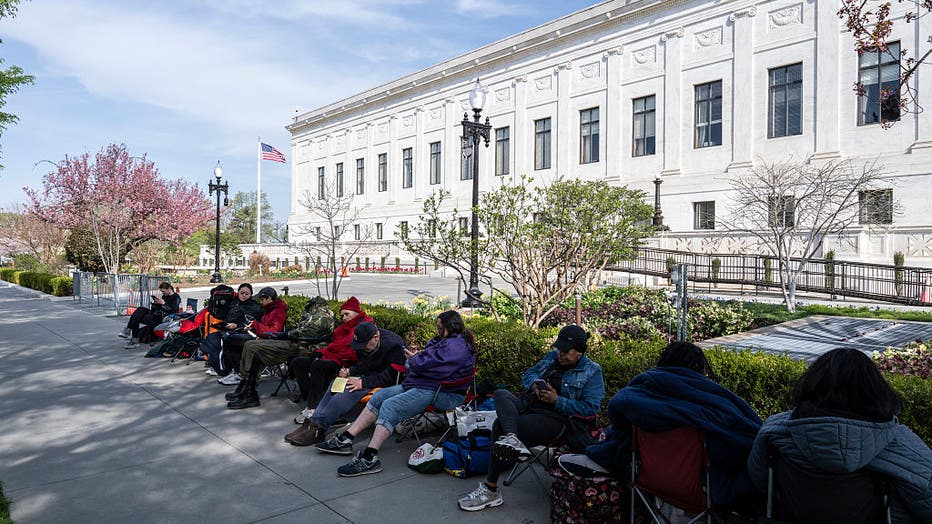
People wait in line outside the Supreme Court Justice building to attend oral arguments on birthright citizenship a day before the court is scheduled to address the case, on March 31, 2026 in Washington, D.C. The Supreme Court is set to convene on Ap
Soon after President Trump signed the executive order, several federal district judges issued preliminary injunctions blocking its implementation nationwide, ruling that the order was likely unconstitutional because it conflicted with the Citizenship Clause, according to The Associated Press.
Immigrants' rights groups such as CASA, the Asylum Seeker Advocacy Project and the American Civil Liberties Union (ACLU), sued to block the order as well.
After that, the Supreme Court partially stayed the lower court injunctions, limiting nationwide blocks while the case remains pending.
The case, Trump v. Barbara, is named for the lead plaintiff, who represents a class of children born in the U.S. who would be affected by the order, per the ACLU.
What is birthright citizenship?
Dig deeper:
Birthright citizenship guarantees that anyone born in the United States automatically becomes an American citizen, according to the American Immigration Council.
This principle has been in place for over a century and applies even to children born to parents who are in the country illegally or are visiting on tourist or student visas, regardless of whether they plan to return to their home country, per the Council on Foreign Relations.
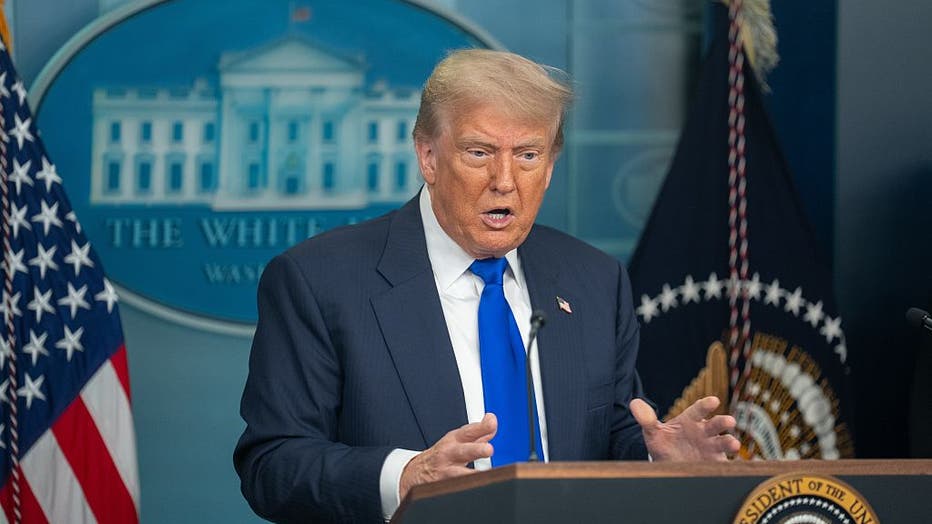
U.S. President Donald Trump attends a press conference at the White House in Washington, D.C., the United States, on June 27, 2025. The U.S. Supreme Court ruled on Friday that district judges lack the authority to grant nationwide injunctions against
A landmark case in the history of birthright citizenship came in 1898, when the U.S. Supreme Court ruled in United States v. Wong Kim Ark that a man born in San Francisco to Chinese immigrant parents was indeed a U.S. citizen. The federal government had attempted to deny him reentry after a trip abroad, arguing that he was not a citizen under the Chinese Exclusion Act—but the Court rejected that claim, affirming that birth on U.S. soil confers citizenship.
Why does Trump want to end birthright citizenship?
Big picture view:
Trump signed the executive order on Jan. 20, 2025, the same day he was inaugurated for a second term. In the order, Trump called American citizenship "a priceless and profound gift."
Granting birthright citizenship is not universal internationally, and Trump and his supporters have argued that the U.S. immigration system is being abused and should have tougher standards.
Opponents warn that ending birthright citizenship could cause serious harm.
"One of our big benefits is that people born here are citizens, are not an illegal underclass," Alex Nowrasteh, vice president for economic and social policy studies at the pro-immigration Cato Institute told FOX Local last year.
About 4.6 million U.S. children under 18 live with at least one parent in the country illegally, and most of these children are U.S. citizens, according to Pew Research Center data from 2023.
Additionally, the Migration Policy Institute told Trump's campaign for president in 2015 that the number of people in the country illegally would "balloon" if birthright citizenship were repealed, creating "a self-perpetuating class that would be excluded from social membership for generations."
The Source: This report draws on President Donald Trump’s executive order, the United States Supreme Court and SCOTUSblog, The Associated Press and research from major immigration and policy organizations, including CASA, the Asylum Seeker Advocacy Project, the ACLU, the American Immigration Council, the Council on Foreign Relations, the Cato Institute, the Pew Research Center and the Migration Policy Institute, with additional reference to the United States Constitution and the National Constitution Center. Additional reporting was provided by Megan Ziegler, Chris Williams and Heather Miller of FOX Local.