

Northern lights may be visible Friday night in parts of New York
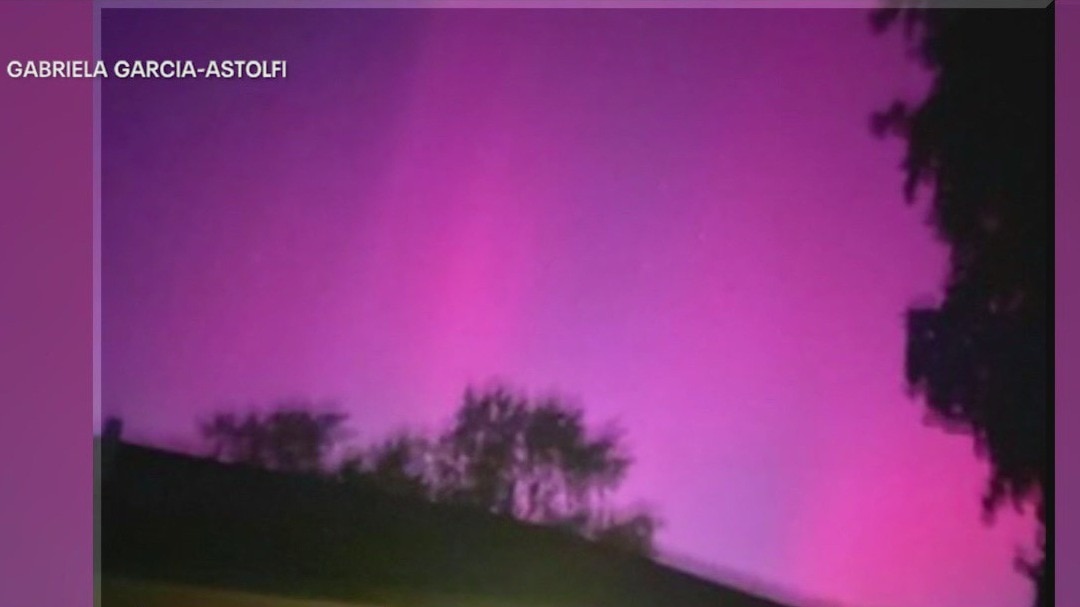
Aurora borealis lights up NYC skies
Skies across the northeast were lit up by a rare aurora borealis on Thursday night thanks a geomagnetic storm, delighting stargazers.
NEW YORK - A moderate geomagnetic storm could make the aurora borealis, or northern lights, visible in nearly 20 states, including New York, Friday night and early Saturday morning.
When will the northern lights be visible?
What we know:
NOAA’s Space Weather Prediction Center says the best time for seeing the northern lights is late Friday night, April 17, through early Saturday, April 18. Typically, skies are darkest between 10 p.m. and 2 a.m.
Where will the aurora borealis be visible?
Local perspective:
According to the Space Weather Prediction Center, the states with the best chance of seeing the northern lights on Friday night are:
- Washington
- Idaho
- Montana
- North Dakota
- South Dakota
- Minnesota
- Wisconsin
- Michigan
- Maine
The following states also have a shot at seeing them, particularly during stronger geomagnetic bursts:
- Oregon
- Wyoming
- Nebraska
- Iowa
- Illinois
- Indiana
- Ohio
- New York
- Vermont
- New Hampshire
How to see the northern lights
Ideally, you’ll want a dark place, far from city lights with a clear view of the northern sky. The darker it is, the brighter the aurora will appear.
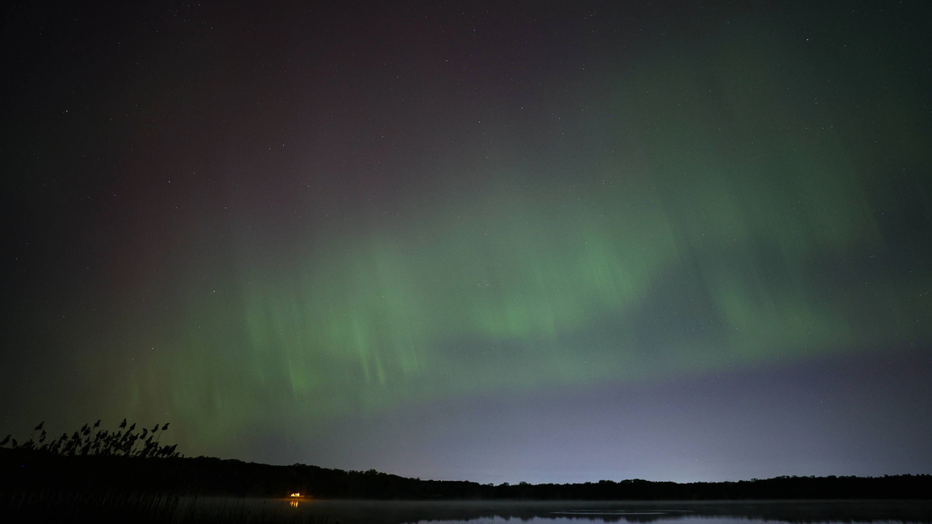
Northern Lights (Aurora Borealis), also known as aurora, colorful lights shift, illuminate the sky in Rochester, New York, United States on May 11, 2024. (Photo by Lokman Vural Elibol/Anadolu via Getty Images)
What are geomagnetic storms?
The backstory:
The sun’s intense magnetic energy is the source of solar flares and eruptions of plasma known as coronal mass ejections. When directed toward Earth, they can create stunning auroras but also disrupt power and communications. These are known as geomagnetic storms. The geomagnetic storm predicted for April 17-18 is level G2, which is considered moderate.
Galileo was among the first astronomers to turn a telescope skyward and study sunspots, back in the early 1600s. Solar flares and coronal mass ejections tend to occur near sunspots, dark patches as big as Earth that are located near the most intense portions of the sun’s shifting magnetic field.
The April 17-18 storm watch is due to a coronal hole, a less dense area in the solar corona, according to NOAA’s Space Weather Prediction Center.
The Source: This article includes information from the National Oceanic and Atmospheric Administration’s Space Weather Prediction Center and previous FOX Local reporting.