

Artemis II live tracker, day 5: Follow NASA's mission to the moon
Original story
The Artemis II astronauts and Orion spacecraft are more than two-thirds of the distance to the moon's lunar surface, NASA said.
The lunar flyby is scheduled for Monday afternoon, April 6, 2026, when Orion's main window will be pointed towards the moon's surface, according to NASA.
On Saturday, Mission Specialists Christina Koch and Jeremy Hansen both took control of the Orion spacecraft conducting a variety of tests and maneuvers.
"For 41 minutes, the pair tested two different thruster modes, six degrees of freedom and three degrees of freedom, to provide engineers with more data about the spacecraft’s piloting capabilities,"" read an update on NASA's Artemis II blog.
When will Artemis II reach the moon?
Artemis II will reach the moon on Monday, April 6, 2026. The six-hour lunar flyby is scheduled to start at 2:45 p.m., NASA said. That's when the Orion spacecraft's main cabin windows will be pointed to the moon.
On Saturday, NASA's lunar science team sent a list of features they want the Artemis II crew to photograph and analyze during their mission.
NASA illustration: Here's how Artemis II gets from Earth to the moon – and back
Artemis II live tracker
NASA has created the Artemis Real-time Orbit Website (AROW), where people can track the Orion spacecraft in real time. Click here to see where the spacecraft and the Artemis II astronauts are.
Watch live: NASA video feed from Orion spacecraft
Here is a live video feed from the Orion spacecraft.
"Viewers will see a blue screen if there is a loss of signal, or if the bandwidth is needed for mission activities. Viewers may see what appears to be a black screen when the vehicle is in darkness."
Timeline: How long does it take to reach the moon?
NASA’s Artemis II mission will orbit Earth for a day, travel to the moon for a flyby beyond its far side, and then return along a free-return trajectory, culminating in Orion’s reentry and a Pacific Ocean splashdown.
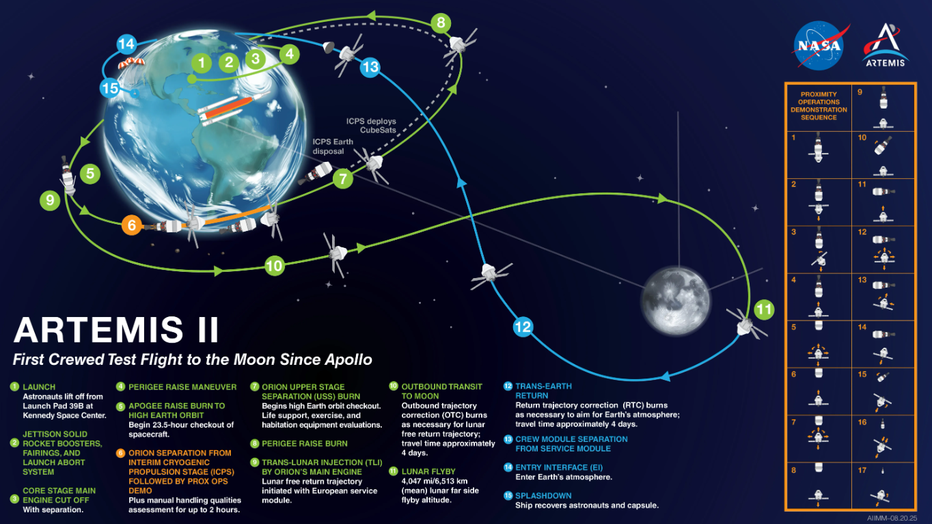
An illustration showing the Artemis II mission. Credit: NASA
- Earth orbit (Day 1): The Artemis II astronauts will orbit Earth for one day to confirm all spacecraft systems are functioning properly.
- To the moon (Days 2–5): Orion’s main engine will fire to propel the capsule out of Earth orbit toward the moon, roughly 244,000 miles (393,000 kilometers) away.
- Moon flyby (Day 6): Orion will reach its farthest point from Earth, passing about 5,000 miles (8,000 kilometers) beyond the moon. Astronauts are expected to document the flyby with cameras and smartphones before heading back to Earth.
- Return (Days 6–9): Using a free-return trajectory, Orion will use the moon’s and Earth’s gravity to guide the spacecraft safely home.
- Reentry: The service module separates, and the capsule re-enters Earth’s atmosphere, facing temperatures up to 3,000°F (1,650°C).
- Splashdown: The Artemis II crew will parachute into the Pacific Ocean, completing the mission much like Apollo astronauts did decades ago.