

Columbia protester Mahmoud Khalil won't be released: Details

Mahmoud Khalil remains detained despite judge's ruling
Mahmoud Khalil, a Columbia University protester, is detained by the Trump administration over green card allegations, despite a judge's ruling against holding him for foreign policy concerns. FOX 5 NY's Jessica Formoso has the latest.
NEW YORK - The Trump administration continues to detain Columbia University protester Mahmoud Khalil, despite a federal judge's ruling against holding him based on potential harm to American foreign policy. Khalil, a legal U.S. resident, is now being held on allegations related to his green card application instead.
The former Columbia University student has been in ICE custody for over three months over his participation in pro-Palestinian demonstrations.
Timeline: Why Khalil wasn't released despite judge's ruling
Timeline:
U.S. District Judge Michael Farbiarz in New Jersey ruled Wednesday that the government must release Khalil, as lawful permanent residents are virtually never detained for posing "potentially serious adverse foreign policy consequences." Farbiarz gave the government until Friday to appeal.
By Friday morning, lawyers for Khalil urged a federal judge saying President Donald Trump's administration missed a 9:30 a.m. appeal deadline after the judge ruled he should be freed and noting Khalil met all court requirements, including posting a $1 bond.
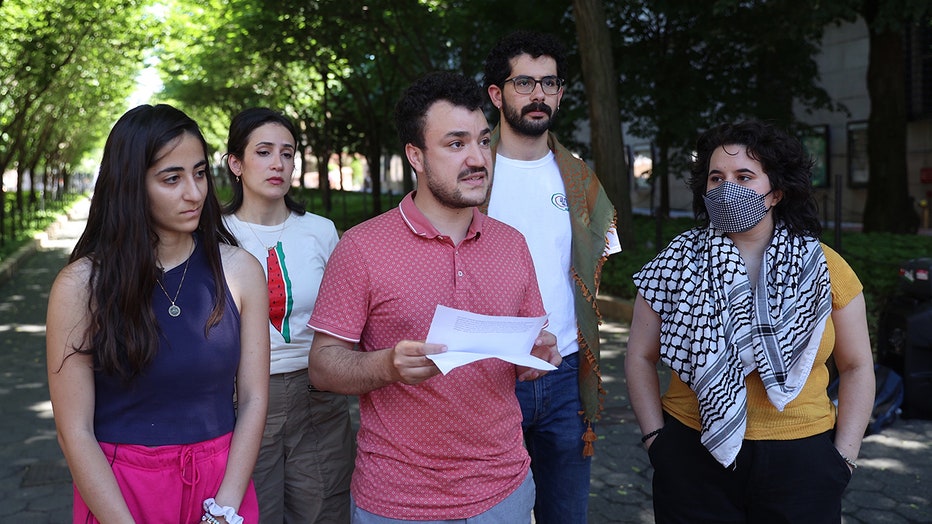
Columbia University student Mahmoud Khalil (C) talks to the press during the press briefing organized by Pro-Palestinian protesters who set up a new encampment at Columbia University's Morningside Heights campus on Friday evening, in New York City, U
In response to the letter, the judge gave the government until 1:30 p.m. Friday to formally reply to the latest request to free Khalil.
In its formal reply, the Trump administration said it was holding Khalil over allegations that he lied on his green card application, not over his involvement in pro-Palestinian demonstrations.
Khalil disputes the claims about his green card application, asserting he was never employed by the United Nations Relief and Works Agency for Palestine Refugees, but completed an internship as part of his graduate studies.
What's next:
The federal court clerk’s office indicated that Judge Farbiarz will respond to the arguments from both sides in a future filing. Meanwhile, Khalil's lawyers, supported by the ACLU, continue to push for his release, emphasizing the unconstitutional nature of his detention.
Who is Mahmoud Khalil?

Mahmoud Khalil breaks silence from detention center
For the first time since his arrest by ICE agents, Khalil is speaking out, claiming he is being targeted and calling himself a political prisoner. FOX 5 NY's Briella Tomassetti has more on what the activist is saying.
Khalil, a 30-year-old Palestinian by ethnicity who was born in Syria, was arrested back on March 8 in New York and taken to a detention center in Louisiana.
The immigration detention center in Jena, Louisiana, is thousands of miles from his attorneys and wife (a U.S. citizen), who gave birth to their first child while he was in custody.
He recently finished his coursework for a master's degree at Columbia’s school of international affairs.
The backstory:
Khalil has adamantly rejected allegations of antisemitism, accusing the Trump administration in a letter sent from jail last month of "targeting me as part of a broader strategy to suppress dissent."
"Knowing fully that this moment transcends my individual circumstances," he added, "I hope nonetheless to be free to witness the birth of my first-born child."
Facing a deadline from an immigration judge to turn over evidence for its attempted deportation of Khalil, the federal government submitted a brief memo, signed by Secretary of State Marco Rubio, citing the Trump administration’s authority to expel non-citizens whose presence in the country damages U.S. foreign policy interests.
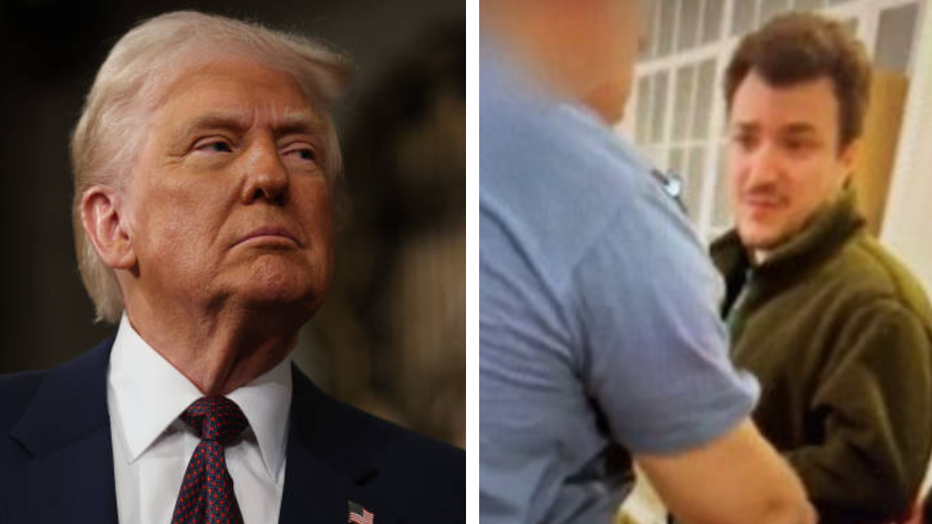
The two-page memo, which was obtained by the Associated Press, does not allege any criminal conduct by Khalil.
Rather, Rubio wrote, Khalil could be expelled for his beliefs.
Judge Farbiarz had ruled earlier that expelling Khalil from the U.S. on those grounds was likely unconstitutional.
Big picture view:
The Trump administration has pulled billions of dollars in government funding from universities and their affiliated hospital systems in recent weeks as part of what it says is a campaign against antisemitism on college campuses, but which critics say is a crackdown on free speech. To get the money back, the administration has been telling universities to punish protesters and make other changes.

NYC anti-ICE protesters clash with NYPD
Dozens of anti-ICE protesters clashed with the NYPD in Lower Manhattan, leading to over 80 arrests. FOX 5 NY's Briella Tomassetti has the latest details.
The U.S. government has also been revoking the visas of international students who criticized Israel or accused it of mistreating Palestinians.
At the time of Khalil's arrest, a Department of Homeland Security spokesperson accused Khalil of leading activities "aligned to Hamas," referring to the militant group that attacked Israel on Oct. 7, 2023.
But the government has not produced any evidence linking Khalil to Hamas, and made no reference to the group in their most recent filing.