

States add gun safety to school curriculums
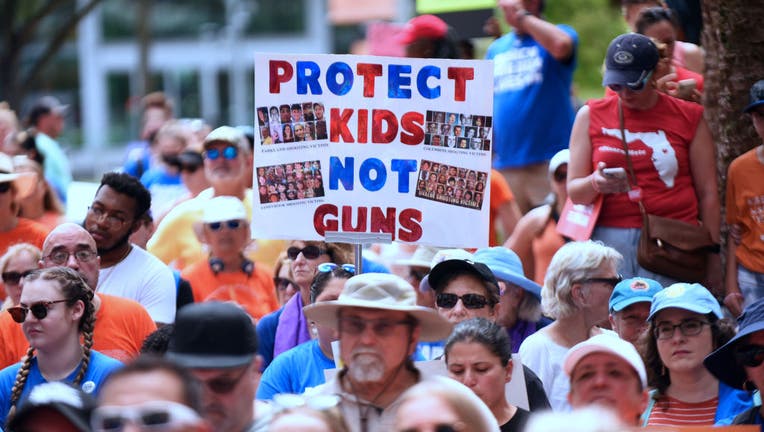
Gun safety advocates participate in the 'March For Our Lives' rally in downtown Orlando, Florida, United States on June 11, 2022 . (Photo by Paul Hennessy/Anadolu Agency via Getty Images)
Students as young as five in several states are being taught what to do if they find a gun, as new laws in Arkansas, Tennessee and Utah make firearm safety lessons a required part of the school curriculum.
Only Utah's law allows students to opt out of the lesson if requested by parents or guardians.
A similar law in Arizona was vetoed by the Democratic governor, and lawmakers in at least five other states have introduced such proposals, putting schools at the forefront of yet another debate about gun violence.
In Tennessee, lesson plans could include stickers, games, quizzes, or videos with music and colorful firearm illustrations, including a gun made out of Lego-style bricks and an explanation of what a muzzleloader is.
Dig deeper:
The lessons are often adapted from hunting safety courses already administered by state hunting and wildlife agencies, but with key differences.
Hunter safety courses typically involve hands-on instruction and explanations of how to safely handle and fire a gun. These classroom lessons, on the other hand, emphasize that children should not touch a firearm.
The main takeaway is a series of steps for when a child finds a gun: Stop, don't touch, leave quickly, tell an adult. This is consistent with instructions created by other organizations, including one from the National Rifle Association that features animated characters, videos and coloring pages.
The states gave school districts some discretion on whether to use provided lesson plans or go with other instructions that adhere to the laws' language. The schools also can decide which faculty or staff will lead the lessons, or in some instances bring in police officers to talk about gun safety.
Local perspective:
At Berclair Elementary School in Memphis, a class of 16 fifth graders were asked how many had seen a real gun. Nearly all raised their hands.
"It just shows you how much a class like this is needed," said Tammie Chapman, a health and physical education instructor, who has been leading the lessons at this school.
"While there is some controversy around guns, there doesn’t always have to be," said Emily Buck, director of public relations for the Tennessee Wildlife Resources Agency, which created a curriculum with the state Department of Education. "I think that having some education and foundational knowledge really can be beneficial in the long run."
Big picture view:
Gun legislation is a partisan issue across the U.S., with Democratic-led states enacting more limits on access to guns and efforts to tighten gun laws often failing in Republican-controlled legislatures.
Republicans sponsored and supported the education bills in Arkansas, Tennessee and Utah. The legislation says the curriculum must have neutral viewpoints on any gun-related topics, such as gun ownership in general.
Voices for a Safer Tennessee, a nonpartisan nonprofit created by parents after The Covenant School shooting in Nashville, supported the legislation. The organization supports gun ownership and advocates for policies like expanded background checks.
These lessons may encourage families to start necessary conversations, said Jessica Jaglois, director of communications for the organization.
"It could possibly prevent a firearm tragedy from occurring, because we know that a moment of access can lead to a lifetime of tragedy," said Jaglois.
Why you should care:
In 2022, the U.S. Centers for Disease Control and Prevention found that firearms were the leading cause of death among children and teens. Arkansas and Tennessee have rates of firearm deaths among children and teens that exceed the national average, according to an AP analysis. But some Democrats and gun control advocates argue this kind of legislation is the wrong approach to gun violence.
The Source: The Associated Press contributed to this report. The information in this story comes from state education and legislative records in Arkansas, Tennessee, and Utah, as well as interviews with teachers, state wildlife officials, and nonprofit representatives involved in creating or supporting the new gun safety programs. This story was reported from Los Angeles.