

World Cup penalty takers keep gambling on the stutter step. Is it costing them?
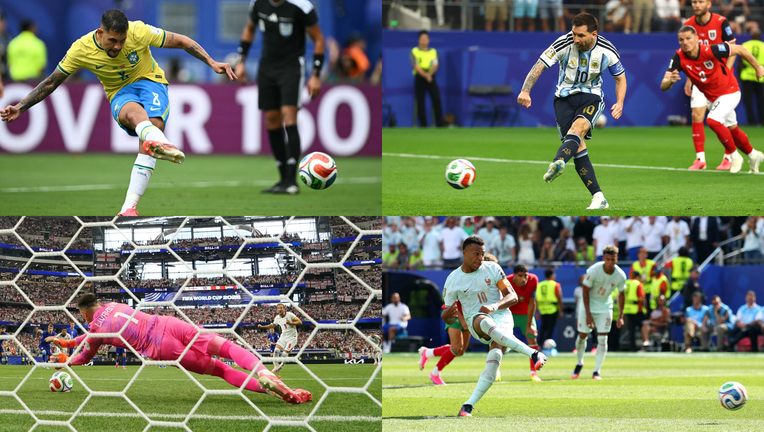
(Photos: Getty Images)
NEW YORK - The stutter-step penalty has become one of the defining debates of this World Cup, with stars including Kylian Mbappé, Lionel Messi and Bruno Guimarães among the players who have missed or been denied after hesitation-style run-ups.
The technique is meant to freeze the goalkeeper and create control from the spot, but after reviewing every official penalty taken so far, the cleaner, more direct approach has produced better results.
What we know:
For this analysis, every official penalty taken so far at the World Cup was reviewed: 60 total, including 20 in-game penalties and 40 shootout attempts.
Overall, 39 of the 60 penalties were scored. The other 21 were saved, missed, hit the post or crossbar, or went off target.
That works out to a 65% conversion rate and a 35% failure rate.
For context, penalties are usually one of soccer’s highest-probability chances. FBref’s expected-goals explainer says penalty kicks are generally valued between .75 and .80 xG, depending on the model. In this review, World Cup penalties have converted at just 65%.
Only penalties that stood in the official match record were counted. Wiped-out attempts were not included. Retaken penalties were counted only if the retake stood in the official match or shootout record.
The stutter-step question
For this review, a stuttered, staggered or hesitation run-up was defined as an approach where the penalty taker visibly disrupted a normal, continuous run-up with a pause, skip, hop, slowed stride, staggered steps or stop-start motion before striking the ball.
That label is subjective because run-up styles can be interpreted differently.
The review did not count every slow or staggered-looking approach. If the stagger happened early enough and far enough away from the ball, it was not counted unless the rhythm break appeared close enough to the strike to matter.
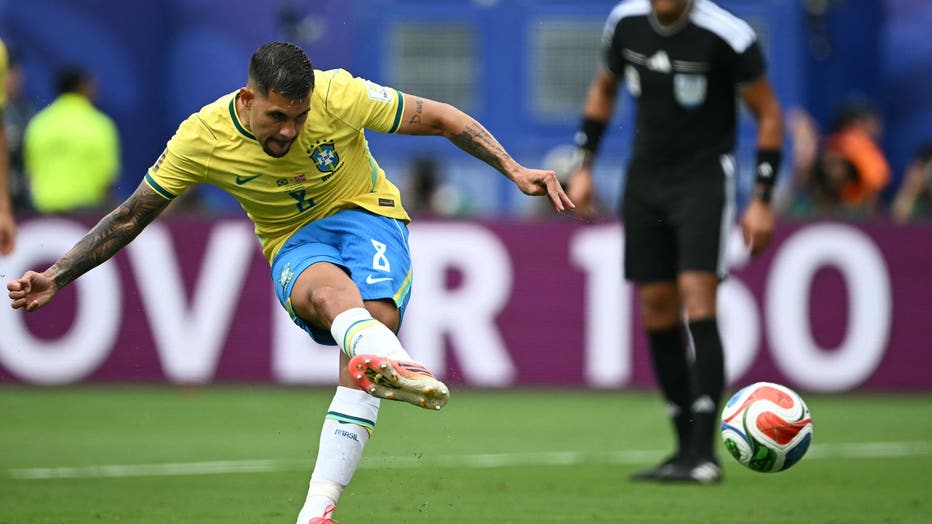
Brazil's midfielder #08 Bruno Guimaraes shoots and misses a penalty during the 2026 World Cup round of 16 football match between Brazil and Norway at the New York/New Jersey Stadium in East Rutherford on July 5, 2026. (Photo by MAURO PIMENTEL / AFP
What the numbers showed
Of the 60 penalties reviewed, 24 were tagged as stuttered, staggered or hesitation run-ups.
Those attempts were scored 13 times and failed 11 times.
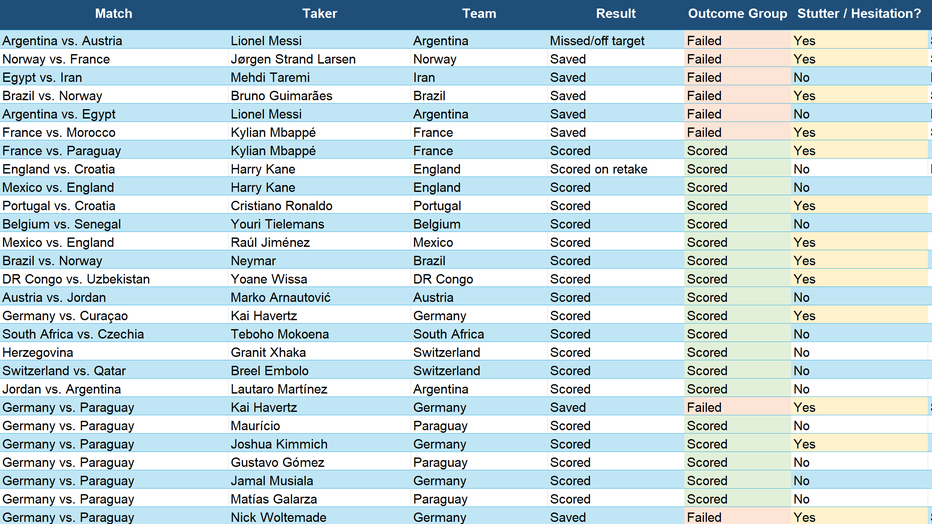
Example of spreadsheet to track penalty data.
That means stuttered or hesitation penalties converted at 54.2% and failed at 45.8%.
The other 36 penalties were tagged as non-stutter run-ups. Those attempts were scored 26 times and failed 10 times.
That means non-stutter penalties converted at 72.2% and failed at 27.8%.
Put simply: players converted 72% of non-stutter penalties, compared with 54% of stuttered or hesitation penalties.
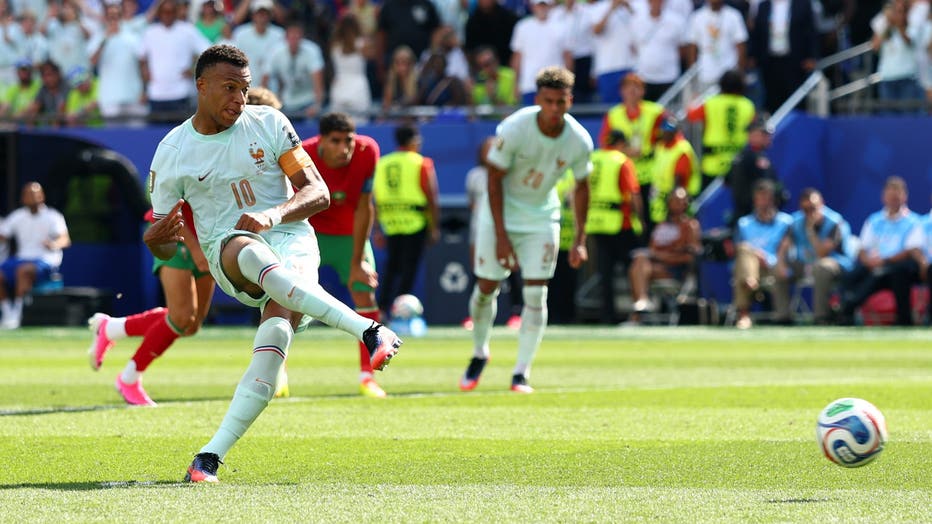
FOXBOROUGH, MASSACHUSETTS - JULY 9: Kylian Mbappe of France misses a penalty during the FIFA World Cup 2026 Quarter Final match between France and Morocco at Boston Stadium on July 9, 2026 in Foxborough, Massachusetts. (Photo by Chris Brunskill/Fan
In-game penalties vs. shootouts
The trend showed up in both in-game penalties and shootouts.
In regular play or extra time, stuttered or hesitation run-ups went 6-for-10, a 60% conversion rate.
Non-stutter in-game penalties went 8-for-10, an 80% conversion rate.
The gap was even more noticeable in shootouts. Stuttered or hesitation shootout penalties went 7-for-14, a 50% conversion rate.
Non-stutter shootout penalties went 18-for-26, a 69.2% conversion rate.
Failed penalties
Of the 21 failed penalties reviewed, 11 came after a stuttered, staggered or hesitation run-up.
That means just over 52% of the failed penalties came after a stutter or hesitation approach.
The other 10 failed penalties came after non-stutter run-ups.
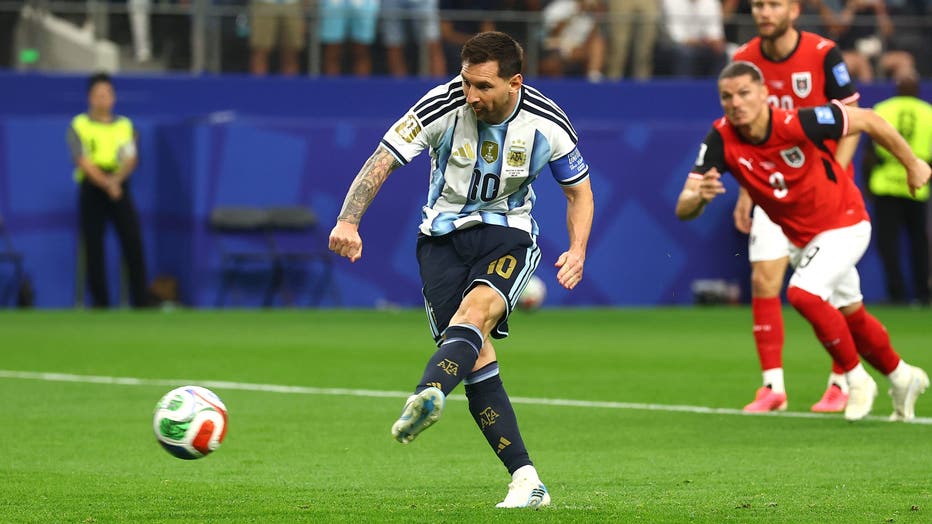
DALLAS, TEXAS - JUNE 22: Lionel Messi of Argentina misses a penalty during the FIFA World Cup 2026 Group J match between Argentina and Austria at Dallas Stadium on June 22, 2026 in Dallas, United States. (Photo by Chris Brunskill/Fantasista/Getty I
The Kane caveat
Harry Kane also had a stuttered penalty saved against Croatia, but that first attempt was retaken.
Kane scored on the second attempt without hesitating his run-up.
Because the first attempt was wiped out, it was not included in the official 60-penalty count. It can be discussed as a separate example, but it is not part of the official review numbers.
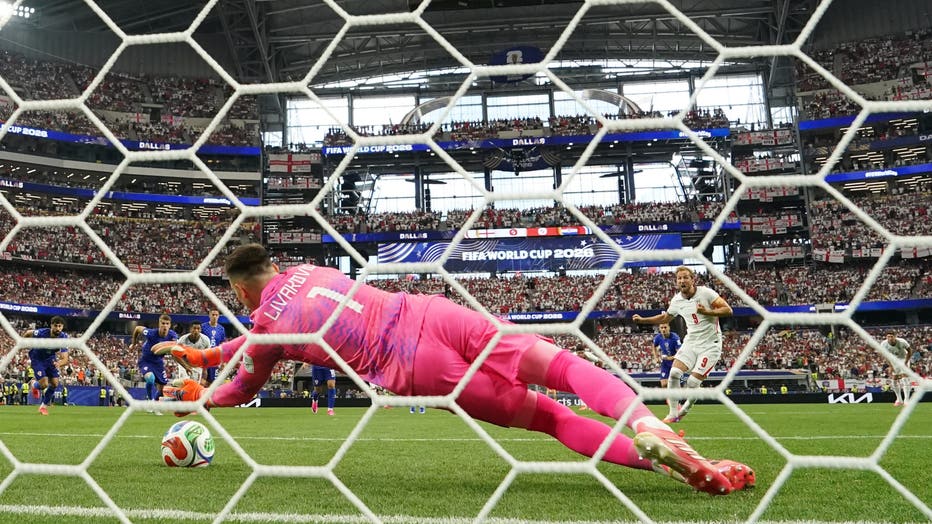
England's Harry Kane misses from a penalty before it is retaken after encroachment by Croatia during the FIFA World Cup Group L match at Dallas Stadium, Arlington. Picture date: Wednesday June 17, 2026. (Photo by Nick Potts/PA Images via Getty Images
Is the stutter step legal?
The stutter step is not automatically illegal.
Feinting or hesitation during the run-up is generally allowed. Feinting after the run-up is completed, once the player is about to kick the ball, is not allowed.
So the issue is not whether the stutter step should be framed as illegal. The better question is whether it is actually working.
The bottom line
This review does not prove that stuttered run-ups caused players to miss. Penalties are affected by pressure, goalkeeper reads, placement, power and the moment itself.
But through 60 official penalties reviewed, the simpler approach has worked better.
Players converted 72% of non-stutter penalties, compared with 54% of stuttered or hesitation attempts.
At this World Cup, just stepping up and striking the ball has been the better bet.
More penalties could still change the numbers
There are still six matches left in the World Cup, and any of them could add to the penalty debate.
As of Saturday, France and Spain had already reached the semifinals, while Norway, England, Argentina and Switzerland were still alive on the other side of the bracket. The remaining schedule includes two quarterfinals, two semifinals, the third-place match and the World Cup Final.

FOXBOROUGH, MASSACHUSETTS - JUNE 16: Erling Haaland #9 of Norway celebrates scoring his team's first goal during the FIFA World Cup 2026 Group I match between Iraq and Norway at Boston Stadium on June 16, 2026 in Foxborough, Massachusetts. (Photo by
Because knockout games go to extra time and then penalties if they remain tied, any of the remaining matches could end in a shootout. That means the numbers in this review could still shift before the tournament ends.
This is especially important because shootouts have been where the stutter-step trend has struggled most. In shootouts, stuttered or hesitation run-ups went 7-for-14, a 50% conversion rate, compared with 18-for-26 for non-stutter attempts.
Methodology
This analysis was based on a video review of all 60 official penalties taken so far at the World Cup.
The review included 20 in-game penalties and 40 penalty shootout attempts. Only penalties that stood in the official match record were counted. Retaken or wiped-out attempts were excluded.
The sample is also relatively small, especially when broken down by run-up type and penalty situation, so the numbers should be read as a tournament trend rather than proof that one technique is always better.
The stutter, stagger or hesitation label is subjective because penalty run-ups can be interpreted differently. For this review, a penalty was tagged as stuttered only when the taker visibly disrupted a normal, continuous run-up with a pause, skip, hop, slowed stride, staggered steps or stop-start motion close enough to the strike to matter.
Some slow or staggered-looking approaches were not counted if the rhythm break happened early enough and far enough away from the ball.
The dataset reflects penalties reviewed through this point in the tournament and will need to be updated if more penalties are taken.
The Source: This article was written using a video review of official World Cup penalty attempts, official match records and FBref’s expected-goals explainer.