

NYC solar eclipse Wednesday: What time it starts, when it peaks and how to watch

Total solar eclipse wows North America
A chilly, midday darkness fell across North America as a total solar eclipse raced across the continent. Monday's spectacle was witnessed by millions of spectators in the U.S., Mexico and Canada. It was North America's biggest eclipse crowd ever, thanks to the densely populated path.
NEW YORK - New Yorkers could get a look at Wednesday’s solar eclipse as the moon passes between Earth and the sun during the early afternoon.
The Aug. 12 event is officially a total solar eclipse, but New York City is outside the path of totality. The city and surrounding region will instead experience a partial eclipse.
What time is the solar eclipse in NYC?
Local perspective:
The partial eclipse is expected to begin in New York City at about 1:07 p.m. Wednesday.
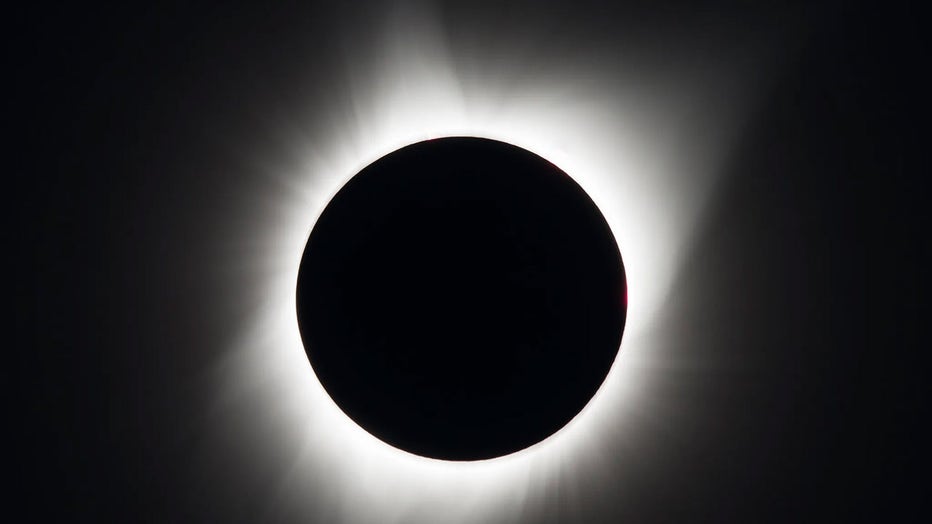
The total solar eclipse on Aug. 21, 2017, was photographed from Madras, Oregon. The black circle in the middle is the Moon. Surrounding it are white streams of light belonging to the Sun’s outer atmosphere, called the corona. (NASA/Aubrey Gemignani)
Maximum eclipse is expected around 1:54 p.m., with the event ending around 2:38 p.m.
The entire partial eclipse will last about an hour and a half in New York City.
What could NYC see?
Because New York City is outside the path of totality, the moon will not completely cover the sun. Instead, viewers could see a portion of the sun obscured by the moon at the peak of the eclipse.
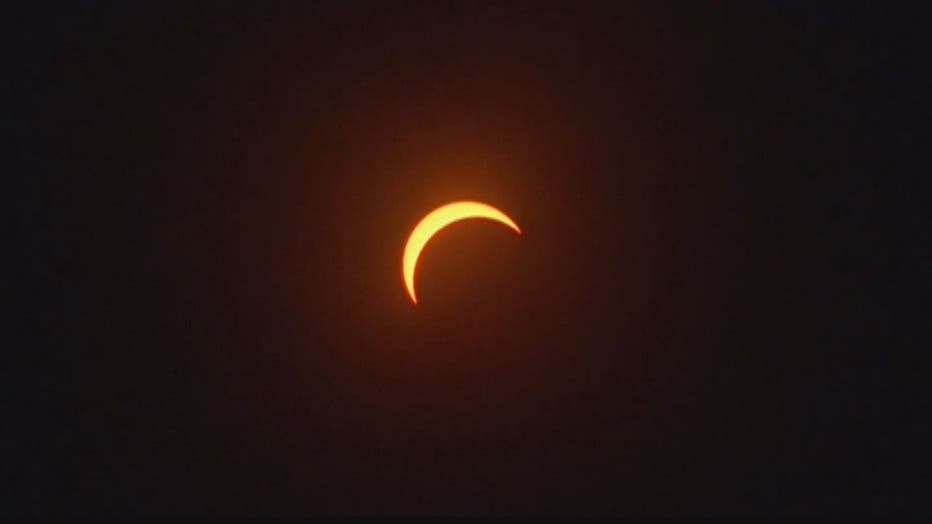
The sky will not become completely dark, and there will be no period of totality in New York City. The partial eclipse will also be visible across other parts of the Northeast.
Total solar eclipse 2026 path: Where will it be visible?
Big picture view:
The path of totality will cross parts of the Arctic and Europe, including Greenland, Iceland and Spain. People inside that path will see the moon completely cover the sun for a brief period. New York and the rest of the Northeast are outside that path.
How to watch the eclipse safely
Because the eclipse will remain partial throughout the entire event in New York City, there will never be a safe time to look directly at the sun without proper eye protection.
Viewers should use eclipse glasses that meet the ISO 12312-2 international safety standard or another appropriate handheld solar viewer. Regular sunglasses are not safe for viewing the eclipse, regardless of how dark they are.
Cameras, binoculars and telescopes also require solar filters specifically designed for those devices. Anyone without eclipse glasses can use an indirect viewing method such as a pinhole projector.
How to watch the eclipse online
People who cannot see the eclipse outside can also follow coverage online.
NASA is expected to provide live coverage from locations along the eclipse path, giving viewers in New York a chance to see the total phase that will not be visible locally.
Perseid meteor shower peaks hours later
The eclipse comes during another major week for skywatchers. The Perseid meteor shower is expected to peak overnight Wednesday into Thursday, giving people another opportunity to look to the sky after the eclipse. The Perseids are typically best viewed away from bright city lights during the late-night and predawn hours.
The Source: This article was written using information from NASA and FOX 5 New York reporting.