

NYC population declines again: Here’s why residents are leaving and where they’re going
Mamdani's grocery plan estimated to cost $30M
FOX 5 NY's political reporter Morgan McKay breaks it down.
NEW YORK - New York City’s population declined again in 2025 after two years of post-pandemic growth, as fewer international migrants arrived and more residents left for other parts of the country, according to a new Citizens Budget Commission (CBC) report.
What we know:
According to the report, the city lost 12,000 residents between June 2024 and July 2025, reversing gains of 70,000 people in 2023 and 163,000 in 2024.
CBC said the recent growth was largely driven by international migration, including the arrival of migrants and asylum seekers. But in 2025, tighter immigration policy reduced international in-migration by 70%, while domestic out-migration ticked up.
What does this mean for NYC?
The report paints a clear picture: New York City is still a global center of opportunity, but its ability to attract and keep residents is under pressure from affordability, taxes, quality-of-life concerns, housing costs and public services.
Where are people going?
Most people who leave the city do not go far. Many move to Long Island, Westchester, New Jersey, Connecticut and Pennsylvania. Among those leaving the region, the most common destinations are Florida, California, Texas, North Carolina and Georgia.
NJ, FL, PA, CT, TX, CA, NC
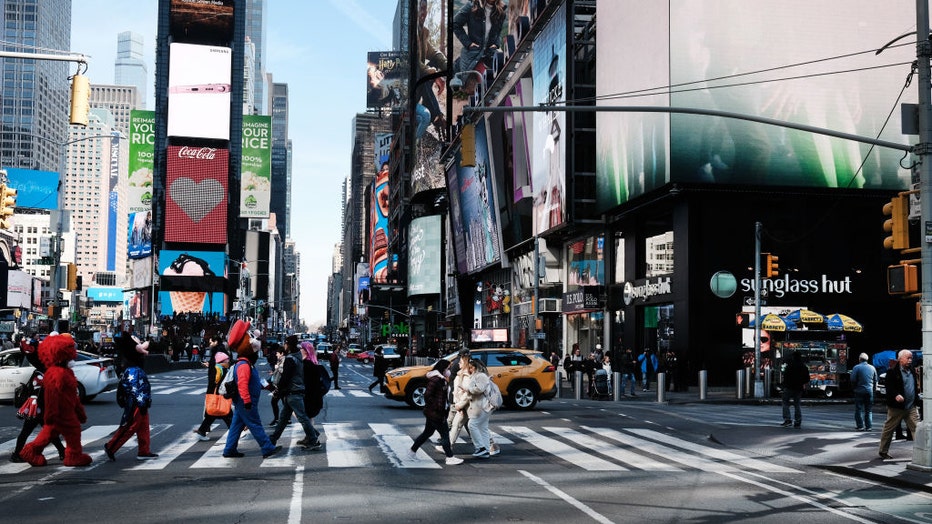
People walk through Times Square on March 11, 2022 in New York City two years since the pandemic. (Spencer Platt/Getty Images)
By the numbers:
Between 2019 and 2023, New York City saw a net loss of 286,239 residents to other parts of New York state, 192,347 to New Jersey, 106,134 to Florida, 61,910 to Pennsylvania and 51,193 to Connecticut. Texas saw a net gain of 24,987 former New York City residents during that five-year period.
Cost of living, taxes, quality of life
CBC said the trend suggests many former residents are finding a stronger "value proposition" elsewhere — a better mix of cost of living, taxes and quality of life. Florida and Texas, in particular, have lower taxes.
What does this mean for the NYC economy?
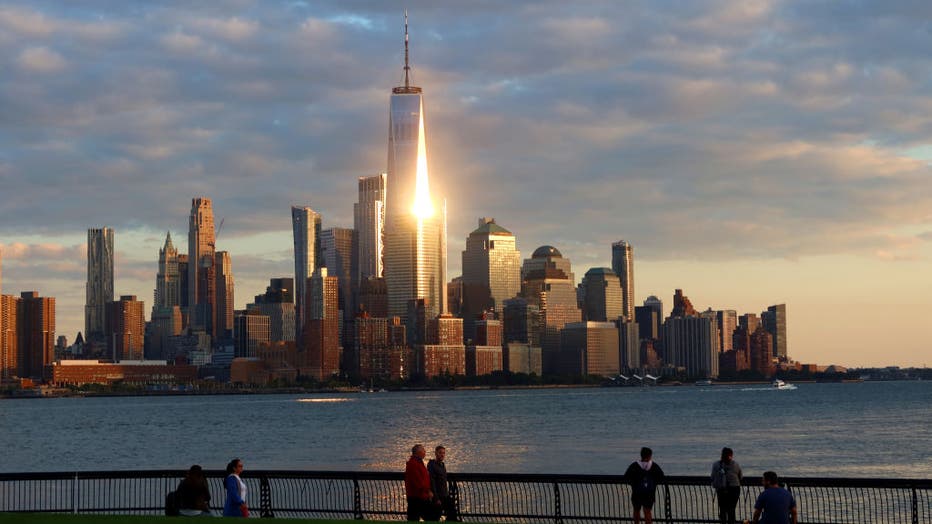
HOBOKEN, NJ - OCTOBER 5: People walk through the park on Pier A as the sun sets on lower Manhattan and One World Trade Center in New York City on October 5, 2020 in Hoboken, New Jersey. (Photo by Gary Hershorn/Getty Images)
The population loss also has financial consequences.
From 2019 to 2023, New Yorkers who moved out earned $68 billion more than those who moved into the city. That includes a $14 billion shift to Florida, $2 billion to Texas and $23 billion to other parts of New York state.
Is NYC worth the cost?
The report found that more New Yorkers of all incomes, races, ethnicities and ages moved to other parts of the U.S. than moved in.
CBC said that signals many residents, across different backgrounds, no longer see the city’s value as worth the cost.
During the pandemic, out-migration accelerated among white New Yorkers, households in the top 40% of income and Millennials. More recently, out-migration fell below pre-pandemic levels for most groups, but it edged up in 2024 among Hispanics, households in the bottom 40% of income and Millennials.
Fewer school age children
The report also flags a related warning sign for families: fewer school-age children. New York City’s school-age population fell by 102,800 students during the two peak COVID school years, reaching 1.17 million in the 2022-23 school year.
Since then, enrollment has risen modestly by 10,500 students, driven in part by migrants and asylum seekers — a boost CBC said is not expected to persist.
Why you should care:
The report finds that the city’s challenge is simple: New York will never be cheap or easy, but it must offer enough value to keep people here.
"The city has long been a magnet for talent and opportunity," the report said, "but recent out- and in-migration changes… reveal a future that may not replicate past growth."
The Source: This report is based on information from Citizens Budget Commission (CBC) report.