

FDA clears use of AI tool designed to predict whether breast cancer will recur
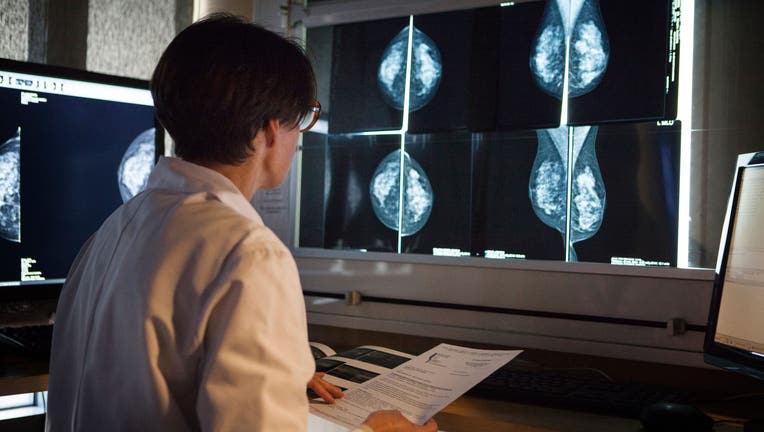
In this file image, a radiologist looks at the results of mammograms in France. (Photo by: BSIP/Universal Images Group via Getty Images)
The U.S. Food and Drug Administration has given clearance for the use of an AI tool designed to help predict the chances that breast cancer will come back after treatment, the product’s maker says.
Big picture view:
SimBioSys, a Chicago-based company specializing in AI-driven medicine, announced the clearance for its TumorSight Risk software.
The software uses data that includes age, race, cancer stage, nodal status and grade, and MRI data from previously diagnosed invasive breast cancer patients.
The software generates 5-year and 10-year risks of breast cancer recurrence, FDA documents state. It provides a score from 0 to 100 that establishes a risk category of "high," "intermediate" or "low" risk.
The company says it can predict the risks based on data that has already been collected rather than requiring any additional procedures, tissue shipment or specialized hardware.
What they're saying:
SimBioSys says its TumorSight Risk software is the world’s first AI-powered, MRI-derived prediction tool for assessing the risk that breast cancer could return.
"For the first time, clinicians can use the rich biological and spatial information already captured in a patient’s breast MRI—together with standard pathology and clinical factors—to gain personalized insight into recurrence risk," SimBioSys President and CEO Stacey Stevens said.
She said it has the potential to expand access to information that can help doctors and their patients make decisions "with greater clarity and confidence."
Why you should care:
Breast cancer is the most common cancer in women in the United States next to skin cancers, according to the American Cancer Society. Breast cancer accounts for about 1 in 3 new cancers in women each year.
The organization estimates that in 2026 alone, nearly 322,000 new cases of invasive breast cancer will be diagnosed in women and that approximately 42,000 women will die from it.
A woman is considered to be at average risk if she does not have:
- A personal history of breast cancer
- A strong family history of breast cancer
- A gene mutation known to increase the risk of breast cancer, like the BRCA gene
- A history of chest radiation therapy before the age of 30
Men can also get breast cancer, though it is more common in women.
The Source: Information in this story came from SimBioSys, the U.S. Food and Drug Administration and the American Cancer Society. This story was reported from Orlando.