

Wash your hands, not your turkey — and other ways to keep your Thanksgiving dinner safe
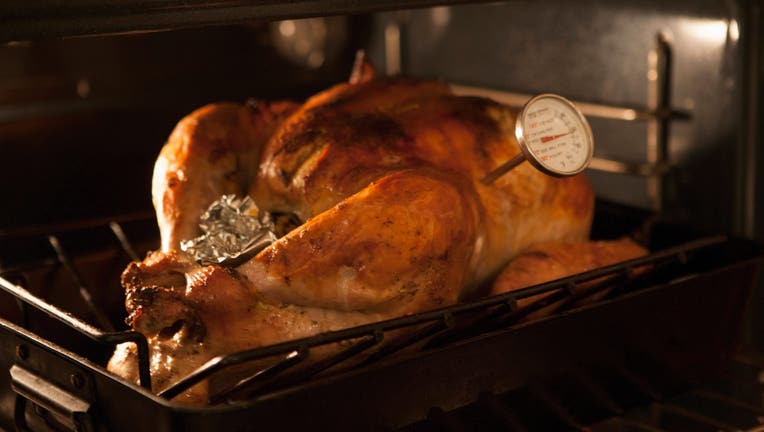
Health experts say it's critical to make sure the internal temperature of the Thanksgiving turkey reaches 165 degrees, which you should confirm with a meat thermometer. (Photo by: Education Images/Universal Images Group via Getty Images)
As Americans prepare for family time around a big meal, food safety experts are warning that food poisoning cases increase during the holidays as the excitement (and stress) of preparing Thanksgiving dinner can make even the simplest tips slip people’s minds.
Big picture view:
Most people have heard of E coli and salmonella, bacteria that can cause foodborne illnesses. But those bacteria are more common in summer months. But while they’re present year round, a different microorganism, Clostridium perfringens, gets much of the blame for an annual spike in food poisoning cases in November and December, when people are preparing and enjoying big holiday feasts.
By the numbers:
The Centers for Disease Control and Prevention says approximately 1 in 6 Americans, or some 48 million people, will get sick from a foodborne illness every year. Of those, 128,000 will be hospitalized and 3,000 will die.
The CDC says most outbreaks of C. perfringens happen in November and December, meaning a disproportionate share of nearly 1 million annual cases blamed on that bacteria cluster into these two holiday months.
What you can do:
Health experts say there are four categories of safer food handling that can decrease the chances that you, your family and your dinner guests will regret sitting down to share a meal with you.
Thaw the turkey safely
The U.S. Department of Agriculture says you should always thaw meat in the refrigerator, never on a countertop. That’s because of what scientists call the "temperature danger zone," which is between 40 and 140 degrees Fahrenheit. Bacteria multiply rapidly in this temperature range, and it’s possible for the outside of frozen foods to reach that point long before the interior is thawed, which means you’re potentially allowing bacteria to grow.
The refrigerator allows slower, but safer thawing. Make sure meat and poultry juices do not drip onto other foods.
If you need the thawing to happen a bit faster, place the food in a leak-proof plastic bag or container for faster thawing. Submerge the meet in cold tap water, not warm or hot, and change the water every 30 minutes.
Cook the meat immediately after it is thawed.
Don’t wash the turkey
It may seem counterintuitive, but experts say that once you’re ready to start roasting the turkey, washing it in the sink can cause more illness than it prevents. That’s because rinsing raw poultry or other meats in the sink can splash bacteria like salmonella, campylobacter and other microorganisms onto nearby ready-to-eat foods and onto countertops where it can come into contact with other foods through cross-contamination.
Cooking the food to a safe internal temperature will kill pathogen.
Wash your hands often
Wash your hands before and after you handle foods and especially after you handle raw meats and poultry. Experts say that you should always wash your hands with soap and warm water for 20 seconds. That’s about the length of time it takes to hum the "Happy Birthday" song twice.
Keeping your hands clean as you handle different foods, particularly meats and poultry, can prevent cross-contamination.
Wash surfaces and utensils after each use
Be sure to wash and sanitize cutting boards, dishes, utensils and countertops with hot, soapy water, especially after they’ve handled raw poultry, meats, seafoods or eggs.
How long do you cook everything
Think you can tell just by looking at the turkey when it’s ready to eat? Think again.
Experts say the only way to know for sure that you’ve cooked turkey (and other meats) to the right temperature is to use a food thermometer.
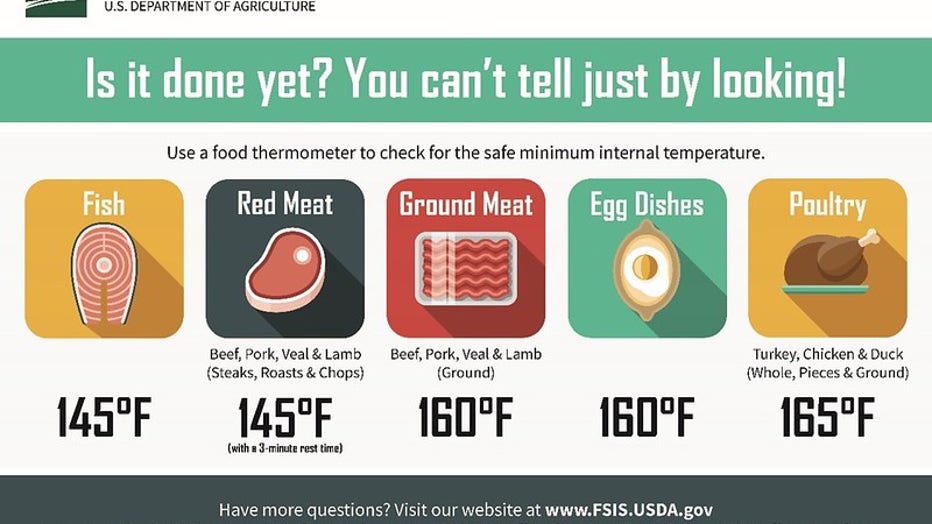
The USDA says it's important to make sure the Thanksgiving turkey is cooked to an internal temperature of 165 degrees before serving it. (Photo: USDA)
The USDA says fish and red meat should be cooked to an internal temperature of 145 degrees. Ground meat and egg dishes should reach an internal temperature of 160 degrees. But for poultry, including turkey, chicken and duck, — whole, pieces and ground — the internal temperature should reach 165 degrees. If your family cooks the stuffing inside the turkey, its internal temperature should also be allowed to reach 165 degrees before you eat it.
When the meal starts, the race begins
Once the feast begins and the food is placed on the table, give yourself two hours. That’s the limit for how long cooked food should sit out at room temperature. That temperature danger zone can allow bacteria to grow in food left out for too long. That bacteria can then cause illness if the food isn’t reheated before being eaten.
Never leave perishable food, such as meat, poultry, eggs, and casseroles, in the danger zone for longer than two hours, the USDA says.
Reheat leftovers until the internal temperature reaches 165 degrees and be sure to stir the food to make sure it heats evenly.
Keep leftovers safely cold
Make sure your refrigerator’s temperature setting sits at 40 degrees or lower.
It’s safe to keep leftovers for three to four days in the refrigerator. If you can’t finish the leftovers within that time, freeze them right away, but frozen leftovers will usually taste better if you eat them within three to four months.
After three to four days, germs can begin to grow, even in a refrigerator set below 40 degrees.
Experts say it’s OK to put hot foods directly into the refrigerator. You can divide large pots of food, like soups and stews, and large cuts of meats like roasts, into smaller quantities for the fridge. This can help food cool quickly enough to prevent bacteria from growing.
The Source: Information for this story came from the Centers for Disease Control and Prevention, FoodSafety.org, the Mayo Clinic, Michigan Medicine at the University of Michigan and previous LiveNOW from FOX reporting. This story was reported from Orlando.